


The official MCP registry answers one question well: what did a publisher declare? A name, a version, a remote URL or a package, a description. It does not say whether that URL answers without an account, how many tools it offers, or whether the tool list changed last Tuesday. Nothing in the registry is wrong about that; it was never meant to record it.
That gap matters more now that registries are becoming policy. GitHub Copilot lets an organisation or enterprise admin enter an "MCP Registry URL" and choose between "Allow all", where the registry's servers are recommendations, and "Registry only", where developers can run only what the registry lists (GitHub docs; public preview). The admin who builds that list sees whatever the registry holds, which is the declaration.
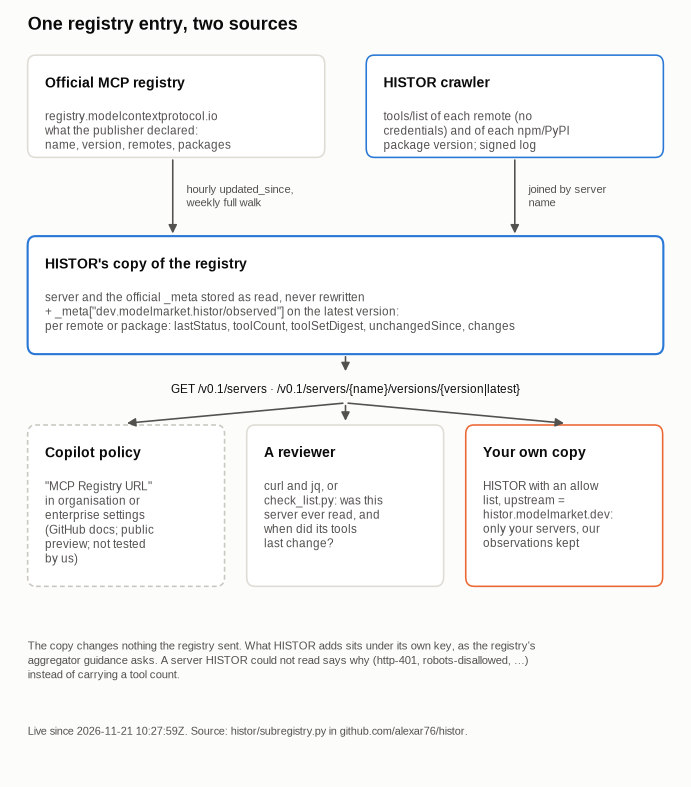
HISTOR, the log we run, has been reading the tool lists of the servers in that registry since October: every remote without credentials on a schedule, and every npm and PyPI server package once per published version. Since 21 November it also serves a copy of the registry in the registry's own v0.1 API, with what it saw attached to each server. The base URL is https://histor.modelmarket.dev.
What an entry looks like
Every route of the official API is there: GET /v0.1/servers with cursor, limit, search, updated_since and version, plus /v0.1/servers/{name}/versions and /v0.1/servers/{name}/versions/{version} (or latest). The server object and the registry's own _meta block come back exactly as the official registry sent them. HISTOR's part sits next to them under its own key, dev.modelmarket.histor/observed, which is how the registry's guidance for aggregators asks a subregistry to add data.
Here is our own scanner, WARDEN, read both ways (curl and jq; any recent version):
curl -s 'https://registry.modelcontextprotocol.io/v0.1/servers/io.github.alexar76%2Fwarden/versions/latest' \
  | jq '._meta | keys'
curl -s 'https://histor.modelmarket.dev/v0.1/servers/io.github.alexar76%2Fwarden/versions/latest' \
  | jq '._meta["dev.modelmarket.histor/observed"].targets[] | {endpoint, lastStatus, toolCount, unchangedSince, changes}'
[
  "io.modelcontextprotocol.registry/official"
]
{
  "endpoint": "npm:@aimarket/warden",
  "lastStatus": "ok",
  "toolCount": 9,
  "unchangedSince": "2026-11-18T20:23:31Z",
  "changes": 5
}
Output as of 21 November 2026. One target per remote URL or package the entry declares. Besides the fields above, each target carries the digest of the tool set HISTOR last recorded, the digest of the tool annotations and other extras, when it first pinned the tool list, when it last read it, and a link to the server's page in the log, where every recorded version of the tool list can be diffed.
Most of what it can say, and the part it can't
A record of tool lists is only as good as the share of servers it could read. We walked the whole copy on 21 November and put every server in one bucket, first match wins:
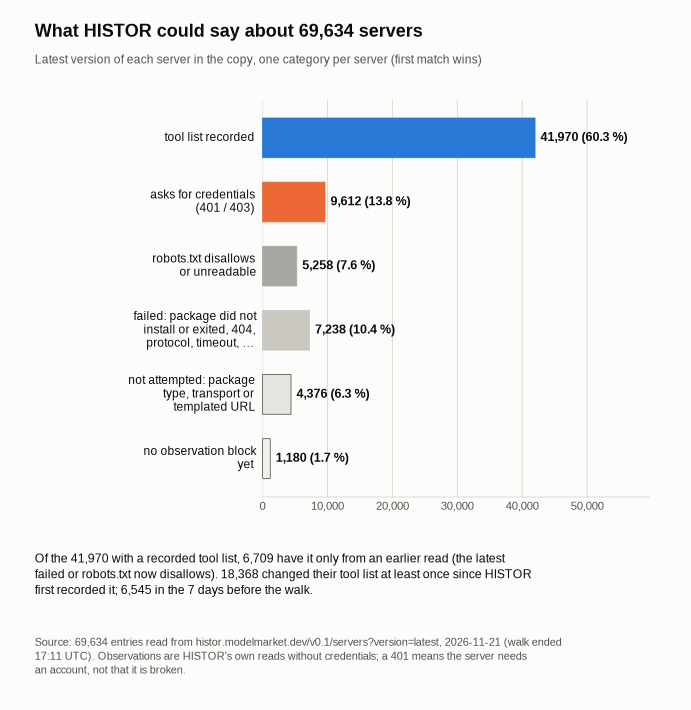
| What the observed block says | Servers | Share |
|---|---|---|
| tool list recorded | 41,970 | 60.3 % |
| asks for credentials (401 / 403) | 9,612 | 13.8 % |
| robots.txt disallows the crawler, or could not be read | 5,258 | 7.6 % |
| failed: package did not install or exited, 404/410, protocol error, private address, timeout | 7,238 | 10.4 % |
| not attempted: package type, transport or templated URL | 4,376 | 6.3 % |
| no observation block yet | 1,180 | 1.7 % |
Source: 69,634 entries read from https://histor.modelmarket.dev/v0.1/servers?version=latest between 17:02 and 17:11 UTC on 21 November 2026, counted with count.py; the per-bucket rules are in its docstring and the result is counts-2026-11-21.json. These are HISTOR's own reads of public definitions, not a test of what the servers do.
For 41,970 servers the copy can tell you how many tools the server offered when it was last read and whether that list has moved: 18,368 of them changed it at least once since HISTOR first recorded it, 6,545 in the last week. For 6,709 of the 41,970 the list comes from an earlier read; the latest one failed, or the site's robots.txt now disallows the crawler. lastStatus and lastObserved say which, so a stale list does not pass for a fresh one. Finding any of this out otherwise means connecting to each server yourself.
The second bar is the honest limit. HISTOR reads without credentials, so a server that asks for an account answers 401 and gets a status instead of a tool list. That includes the servers people are most likely to approve first. GitHub's remote server answers 401, and its container image is a package type HISTOR does not run. Notion's remote answers 401 too. For those, the copy says "we could not read this, and here is why", which is still more than the registry says, but it is not a tool list. The robots bar is a choice on our side: HISTOR honours robots.txt and does not change its user agent to get past it.
Check a list before you approve it
If you already keep a list of server names, a short script reads the copy for each one. check_list.py needs Python 3.9 or newer and nothing outside the standard library:
"""For each server name in a file, print what HISTOR recorded about its latest registry version.

    python3 check_list.py names.txt
Python 3.9+, standard library only. Reads https://histor.modelmarket.dev/v0.1/servers/{name}/versions/latest.
"""
import json
import sys
import urllib.error
import urllib.parse
import urllib.request

BASE = "https://histor.modelmarket.dev/v0.1/servers/"
KEY = "dev.modelmarket.histor/observed"

for line in open(sys.argv[1]):
    name = line.split("#", 1)[0].strip()
    if not name:
        continue
    url = BASE + urllib.parse.quote(name, safe="") + "/versions/latest"
    try:
        with urllib.request.urlopen(url, timeout=30) as r:
            entry = json.load(r)
    except urllib.error.HTTPError as e:
        print(f"{name}: {e.code} (not in the registry copy)")
        continue
    print(f"{name} {entry['server']['version']}")
    observed = entry["_meta"].get(KEY)
    if not observed:
        print("  no observation yet")
        continue
    for t in observed["targets"]:
        if t["toolCount"] is not None:
            print(f"  {t['endpoint']}: {t['toolCount']} tools, changed {t['changes']}x, "
                  f"unchanged since {t['unchangedSince']}, read {t['lastObserved']}")
        else:
            print(f"  {t['endpoint']}: not read ({t['notAttempted'] or t['lastStatus']})")
printf 'io.github.alexar76/warden\nio.github.github/github-mcp-server\ncom.notion/mcp\nio.example/not-there\n' > names.txt
python3 check_list.py names.txt
io.github.alexar76/warden 0.35.0
  npm:@aimarket/warden: 9 tools, changed 5x, unchanged since 2026-11-18T20:23:31Z, read 2026-11-20T20:28:37Z
io.github.github/github-mcp-server 2.2.0
  https://api.githubcopilot.com/mcp/: not read (http-401)
  oci:ghcr.io/github/github-mcp-server:2.2.0: not read (package-type-not-observed)
com.notion/mcp 1.0.1
  https://mcp.notion.com/mcp: not read (http-401)
  https://mcp.notion.com/sse: not read (transport-not-observed)
io.example/not-there: 404 (not in the registry copy)
Run on 21 November 2026. The last name is made up, to show what an unknown name returns.
Your own copy, with only your servers
An organisation's registry is usually a short list, not 69,000 servers. HISTOR can run as exactly that: no crawl of its own, an allow list of names or namespace/* lines, and an upstream that can be the official registry or another subregistry. With histor.modelmarket.dev as the upstream, the observations come along. The published aimarket-histor 0.10.0 on PyPI predates the subregistry, so install from the public source at a fixed commit (Python 3.11 or newer):
python3 -m venv .venv
.venv/bin/pip install "git+https://github.com/alexar76/histor@fb35e7a0681a3ec009d61ccf49ed1858ab6dbc63"
cat > allow.txt <<'EOF'
# servers our developers may use
io.github.alexar76/warden
io.github.github/github-mcp-server
com.notion/*
EOF
export HISTOR_SUBREGISTRY=1 \
  HISTOR_SUBREGISTRY_UPSTREAM=https://histor.modelmarket.dev \
  HISTOR_SUBREGISTRY_ALLOW="$PWD/allow.txt" \
  HISTOR_CRAWL_INTERVAL_S=0 HISTOR_REMOTE_INTERVAL_S=0 \
  HISTOR_DATA_DIR="$PWD/data" HISTOR_PORT=9491
.venv/bin/python -m histor.subregistry sync --full
.venv/bin/python -m histor serve &
sleep 5
curl -s http://127.0.0.1:9491/v0.1/servers \
  | jq -r '.servers[] | [.server.name, .server.version, (._meta["dev.modelmarket.histor/observed"].targets | map(.lastStatus // .notAttempted) | join(","))] | @tsv'
{"at": "…", "mode": "allow-list", "upstream": "https://histor.modelmarket.dev", "pages": 3, "read": 3, "stored": 3, "skipped": 0, "filtered": 0, "gone": 0}
com.notion/mcp  1.0.1   http-401,transport-not-observed
io.github.alexar76/warden   0.35.0  ok
io.github.github/github-mcp-server  2.2.0   http-401,package-type-not-observed
The sync's at field, the local clock's time, is left out above. With an allow list the sync asks the upstream for each listed name instead of walking everything, so the first copy took about four seconds here. The two crawl intervals at 0 mean this instance reads no servers itself; it only keeps the list and serves it. The defaults are SQLite and a development profile. For anything other people rely on, HISTOR wants PostgreSQL and HISTOR_PROFILE=prod, which refuses to start without an https upstream, an https public base and an operator token.
How the copy is kept
The sync follows the routine in the registry's aggregator guidance. The first run walks version=latest; after that it asks for updated_since a checkpoint, with ten minutes of overlap, and moves the checkpoint only once every page has been applied, so an interrupted sync repeats rather than skips. Entries are upserted by name and version. Once a week it walks everything again and marks servers the upstream no longer lists. That step has a guard: the registry is in preview and warns about data resets, so a full walk that returns fewer than half the servers the copy holds marks nothing as gone.
On production the first full copy took about 19.5 minutes (10:28:06 to 10:47:41 UTC): 695 pages, 69,484 entries read, 69,483 stored, one skipped. We then picked 30 entries at random and compared server and the official _meta with the official registry's versions/latest: all 30 were identical. Hourly syncs have run since; the status route, /api/v1/subregistry, shows the last one.
The code is one module, histor/subregistry.py, about 600 lines, with the routes, the sync, the allow list and the shaping of _meta.
What it does not do
- We have not connected it to a Copilot organisation. The routes, the URL form (a base URL; Copilot appends
/v0.1itself, per the docs) and the CORS headers (Access-Control-Allow-Origin: *, methodsGET, OPTIONS) are what the documentation asks for, and the responses match the official registry's, but that is not the same as having watched Copilot read it. If you try it, we would like to hear what happened. - Only the latest version of a server carries an observation. Older versions in the copy come back as the registry sent them.
- An observation is what HISTOR's crawler received without credentials. A server can offer different tools to a logged-in user.
- It is one public instance with no uptime promise, rate-limited to 600 requests a minute per address, with responses cacheable for five minutes. If your hosts depend on it, run your own copy with it as the upstream, as above.
- It does not filter or score anything. Every server the registry lists is in the copy, whatever its observation says. Deciding what to allow stays with you.
We run HISTOR and build WARDEN. AI assistance was used for the code, the count, the figures and this article.


Top comments (10)
The distinction between what a publisher declares and what a server actually returns from tools/list is a useful way to frame registry trust, especially with admins now using a registry as an allow-list. Tool lists changing silently between versions feels like the same problem as unpinned dependencies. When a tool list changes, do you record just the tool names or also the input schemas and descriptions? Description changes seem like the sneakier risk for agents that read them as instructions.
All of it. The digest is over each tool's name, description and input schema together, so a reworded description moves it even when the names and schemas stay put. Annotations (readOnlyHint and the rest) go into a second digest, so a hint flip shows up separately.
For every change the log keeps a diff: tools added and removed, and for each tool that stayed, the description as a word diff and the schemas as a list of JSON paths with old and new values. It also lists any host or e-mail address that appears in the new text and wasn't there before, which is the quickest thing to look at when a description suddenly grows.
On which is more common: of the last 200 changes this morning (07:59–10:23 UTC), 98 touched a description, 96 an input schema, 44 added a tool and 5 removed one. So descriptions change about as often as schemas, and most of those edits never come with a version bump.
You can see the raw records at histor.modelmarket.dev/api/v1/chan...
That breakdown is useful, and it's surprising that descriptions change as often as schemas with no version bump. Since descriptions feed straight into what the model reads, the new host or e-mail listing seems like the most actionable signal. Do you see many of those edits that add a URL to a description, or is that rare?
Rare. In today's last 2,000 changes (02:54–19:50 UTC, 1,337 servers) 58 name a host, an e-mail address or an IP that the tools did not name before. That is about 3%, on 43 servers.
Most of it is unremarkable: the server's own domain, github.com, npm, PyPI and crates.io, lists of government sites in tools that cite official sources, and example addresses in parameter docs. In 23 of the 58 no tool was added, so the address arrived in the text of a tool that was already there. That is the case you are asking about, a bit more than 1 change in 100.
The one I would read first is a link shortener, since the name hides where it goes. There was one today, a bit.ly, and it came with a new tool.
Your question also found a bug on our side. Counting this, I saw the log listing dotted field names such as versions.kitVersion as if they were hosts, which made the list longer than it should be. That is fixed as of this evening and the stored records are recounted, so the numbers above are the corrected ones.
The separate annotation digest is the part I'd want most. Of the annotation changes you've logged, how many flip readOnlyHint or destructiveHint, as opposed to a server adding hints for the first time? The flips are the ones that change what a client lets through without asking.
Mostly first-time hints. In the 30 days the second digest has been recorded (23 Oct to 22 Nov), 16,994 changes touched readOnlyHint or destructiveHint, on 8,034 servers. In 13,686 of them, about 80%, the only thing that happened is a hint appearing where there was none.
A real flip, one value replaced by the opposite one, is in 842 changes on 715 servers: about 5%. They are lopsided. 702 go the way you care about, readOnlyHint from true to false or destructiveHint from false to true, and 159 go the other way. Nearly all of those servers did it once.
The remainder is a hint being dropped, about 2,500 changes. I would count part of that with the flips: a tool that stops saying readOnlyHint: true is no longer auto-approved by a client that trusted it, even though nothing was "flipped".
One caveat on the 80%: "appearing" includes a new tool that arrives with its hints, not only an old tool gaining them. I have not split those two.
Thanks, that's the number I was after. I'd read the two directions the other way round, though. readOnlyHint going true to false, or destructiveHint false to true, makes a client ask more, so those 702 got more careful. The 159 going the other way are the ones to alarm on: a tool that used to need a confirmation can now run without one, and nothing in the version bump says so. Your point about dropped hints holds too. A tool that stops saying readOnlyHint: true loses its auto-approval on a client that trusted it.
You're right, I had that backwards. A hint moving to read-only or to non-destructive is the one that lets a call through without a prompt, so the 159 changes (151 servers) are the ones to alarm on. Per tool that is readOnlyHint false to true on 365 tools and destructiveHint true to false on 220.
That direction now has its own view in the registry copy. A server's page takes ?approval_relaxing=true and then shows only the changes where readOnlyHint went from false to true or destructiveHint from true to false, and the same filter works on that server's Atom feed (/feed.xml?watch=&approval_relaxing=true). It counts explicit flips only. A tool that had no hints and starts saying readOnlyHint: true is not in it yet, and that case matters just as much, since an absent readOnlyHint means "not read-only".
A changed description matters more than a changed count, because the model reads it each time it picks a tool. Does HISTOR flag a description edit as its own change?
Yes. A change record lists tools added and removed, and separately every tool that stayed with the fields that moved in it. A description edit is its own entry there, stored as a word diff, so you can see what was said before and after without fetching both versions.
It is also the common case. Of the last 200 changes (today, 14:59–17:32 UTC), 154 left the list of tools exactly as it was. In 105 of those a description changed, and in 71 nothing changed except descriptions. A count would have reported all 154 as "no change".
Not all of them are worth a human's attention. Some servers put live numbers into the text, a job count or a feed timestamp, and that text moves every hour. Others are real edits: one server today extended a sentence in a tool's description to cover a new case and kept reporting the same version, 1.37.0.
The records are public: histor.modelmarket.dev/api/v1/chan...