

Motivation & Series Roadmap
Storage engines are shaped by the workloads they are built to serve. Today, etcd is best known as the disk-backed datastore behind the Kubernetes control plane. When it started in 2013, however, it was much simpler: an in-memory hierarchical directory tree serialized to JSON.
In this series, we will trace how real-world adoption changed etcd's storage layer over time. This first post starts at the beginning, when small CoreOS configuration trees made keeping everything in memory the obvious choice. In later posts, we will cover the first major reliability overhaul, the arrival of Kubernetes and how it broke those early assumptions, and the move to a disk-backed engine built on BoltDB. From there, we will look at the scaling bottlenecks that led the team to fork BoltDB into bbolt and become database maintainers themselves. Finally, we will bring the story up to the present to see how etcd moved past its original design and what might come after bbolt.
In Part 1, we go back to etcd v0.1 through v0.4 (2013-2014). We will look at the original CoreOS workload, inspect the Go code behind its in-memory store and early Raft persistence, and benchmark a 3-node cluster to measure its throughput and latency limits.
The 2013 Workload: Why CoreOS Needed a Distributed /etc
In 2013, CoreOS set out to change how server infrastructure was operated. Instead of patching long-lived Linux hosts in place with apt or yum, CoreOS Container Linux shipped a minimal, container-only operating system modeled after ChromeOS. It consisted of the Linux kernel, systemd, a container runtime, and immutable dual-partition (A/B) automatic OS updates. Updates were downloaded in the background to the passive partition and activated on reboot.
This minimal design created a coordination problem. Once servers reboot automatically and move containers across a cluster, you need a strongly consistent place to coordinate rolling reboots, schedule services, and share configuration. At the same time, CoreOS wanted to avoid running a JVM and Apache ZooKeeper on minimal Linux hosts. To fill this role, they built etcd (from Unix /etc plus d for distributed and daemon) as a single static Go binary.
To understand what a "distributed /etc" meant in practice, and why this workload shaped etcd's first storage engine, let's look at how etcd sat at the center of a typical CoreOS cluster.
Inside a CoreOS Cluster: Bootstrapping Around etcd
Consider a small CoreOS cluster running a 3-replica web service behind an nginx reverse proxy on three worker machines, backed by a dedicated 3-node etcd cluster. Having three etcd nodes ensures that a single crash or reboot does not take the store down (we will look at how these nodes stay in sync later in this post).
The core design principle of the early CoreOS stack was hub-and-spoke coordination. Daemons on worker machines did not talk directly to each other: schedulers did not open RPC connections to worker agents, and update daemons did not use gossip protocols. Instead, every component only read from and wrote to etcd's shared directory tree:

Going through the bootstrap sequence shows how each part of the cluster maps to a small branch in that tree:
-
Start with an empty root:
etcdstarts first as a shared, hierarchical keyspace, similar to a cluster-wide/etc. -
Workers join via
fleetd: Each CoreOS worker startsfleetd, registers a liveness heartbeat under/_coreos.com/fleet/machines/, and agrees on a single active scheduler (/_coreos.com/fleet/lease/engine-leader, held here by Worker 2). -
An admin deploys services and config: Using
fleetctlandetcdctldirectly againstetcd(in 2013-2014,fleetctlwrote unit definitions directly intoetcdwithout an intermediate API server), an admin submitsweb@1..3andnginxalong with shared application config such as/config/web/rate_limit. The activefleetdscheduler assigns those units to workers, which then start the containers locally. -
Running containers register for discovery: Once running, each
webreplica publishes itsIP:portunder/services/web/. On Worker 3,nginx(driven by a lightweight template helper likeconfd) watches/services/web/so traffic is routed only to healthy backends. -
OS updates take turns via
locksmithd: Every worker also runslocksmithd, which coordinates around a reboot semaphore under/coreos.com/updateengine/rebootlock/semaphore. This makes sure automatic A/B OS updates reboot one machine at a time instead of taking the whole cluster offline at once. (Theetcdnodes themselves runlocksmithdin their own one-at-a-time group for the same reason.)
It is worth noting how little data etcd actually holds once the cluster is up and running. The animation compresses each unit into a single line (13 keys in total). Even in a real CoreOS cluster, where fleet splits each unit across several internal subkeys (object, target, state), the entire working set consists of only a few dozen small keys. Total data size stays well under 1 MB, with a small, steady stream of periodic heartbeat writes.
Storing /etc in RAM: Inside etcd v0.4's store
When the entire cluster's working set fits into a few hundred kilobytes, there is little reason to build an on-disk B+tree or an LSM-tree. Early etcd (v0.1 to v0.4) had no embedded database engine at all. Its primary storage engine was an in-memory Go directory tree (store), exposed over a simple HTTP+JSON API on port 4001.
Looking at store/store.go in etcd v0.4.9, the whole storage engine is represented by a single seven-field struct:
// store/store.go (etcd v0.4.9)
type store struct {
    Root           *node
    WatcherHub     *watcherHub
    CurrentIndex   uint64
    Stats          *Stats
    CurrentVersion int
    ttlKeyHeap     *ttlKeyHeap  // need to recovery manually
    worldLock      sync.RWMutex // stop the world lock
}
Each coordination pattern from our CoreOS bootstrap walkthrough maps directly to one of these fields:
| CoreOS Cluster Need | HTTP+JSON Primitive | Backing In-Memory Structure |
|---|---|---|
Hierarchical /etc paths (fleet, /config/*) |
Directory / leaf CRUD |
Root *node tree (Children map[string]*node) |
Mutual exclusion (locksmithd semaphore, fleetd leader lease) |
Atomic CAS (prevIndex / prevValue) |
Monotonic CurrentIndex + worldLock
|
Ephemeral liveness (fleetd heartbeats, web@1..3 registration) |
Per-key TTLs (ttl=30) |
ttlKeyHeap min-heap |
Reactive config (nginx/confd following /services/web/) |
Long-polling watches (?wait=true) |
WatcherHub + 1,000-slot EventHistory ring buffer |
Let's look at how each of these four components works in the code.
The Directory Tree, worldLock, and Atomic CAS
The root of the store is a Unix-like tree of node structs (store/node.go):
// store/node.go (etcd v0.4.9)
type node struct {
    Path string

    CreatedIndex  uint64
    ModifiedIndex uint64

    Parent *node `json:"-"` // should not encode this field! avoid circular dependency.

    ExpireTime time.Time
    ACL        string
    Value      string           // for key-value pair
    Children   map[string]*node // for directory

    store *store
}
A node is either a leaf (holding a Value string with Children == nil) or a directory (holding a Children map[string]*node keyed by path segment). In memory, our CoreOS cluster's keyspace forms a nested tree of Go structs and maps, with ttlKeyHeap holding direct pointers to the same ephemeral *node structs:

Reading /services/web/web@1 acquires worldLock.RLock(), splits the path, and walks Root.Children["services"].Children["web"].Children["web@1"]. Every write acquires the exclusive worldLock.Lock() (commented // stop the world lock in the source code), increments the store's global monotonic CurrentIndex, and updates the affected node's ModifiedIndex.
Having a single global lock and a monotonic index makes Compare-and-Swap (CAS) straightforward to implement. Take locksmithd coordinating a 3 AM OS reboot on Worker 1 as an example. First, locksmithd reads /coreos.com/updateengine/rebootlock/semaphore and sees modifiedIndex: 5. To claim the reboot slot, it sends a conditional PUT with prevIndex=5:
curl -X PUT http://10.0.0.1:4001/v2/keys/coreos.com/updateengine/rebootlock/semaphore \
  -d prevIndex=5 \
  -d value='{"semaphore":0,"max":1,"holders":["worker-1"]}'
Note that locksmith intentionally acquires this semaphore with prevIndex without a TTL or watch. A rebooting host must keep holding the slot while powered off and only releases it via another CAS after booting back up. Other hosts retry with exponential backoff.
In store.CompareAndSwap (store/store.go), the check and update run atomically under worldLock:
// store/store.go (etcd v0.4.9, trimmed)
func (s *store) CompareAndSwap(nodePath, prevValue string, prevIndex uint64,
    value string, expireTime time.Time) (*Event, error) {

    s.worldLock.Lock()
    defer s.worldLock.Unlock()

    n, err := s.internalGet(nodePath)
    if err != nil {
        return nil, err
    }
    if ok, which := n.Compare(prevValue, prevIndex); !ok {
        cause := getCompareFailCause(n, which, prevValue, prevIndex)
        return nil, etcdErr.NewError(etcdErr.EcodeTestFailed, cause, s.CurrentIndex)
    }

    s.CurrentIndex++
    // ... record Event with PrevNode ...
    n.Write(value, s.CurrentIndex)
    n.UpdateTTL(expireTime)
    s.WatcherHub.notify(e)
    return e, nil
}
If Worker 1 and Worker 2 both send a request with prevIndex=5 at the same time, whichever request runs first advances the node to modifiedIndex: 42. The second request fails n.Compare and receives 101: Compare failed ([5 != 42]).
Ephemeral Keys and ttlKeyHeap
Unlike the reboot semaphore, service registrations and machine heartbeats need to disappear automatically if a worker crashes. When web@1 starts on Worker 1, it registers an ephemeral key with a 30-second TTL:
curl -X PUT http://10.0.0.1:4001/v2/keys/services/web/web@1 \
  -d value="10.0.1.1:8080" \
  -d ttl=30
When store inserts /services/web/web@1 (auto-creating /services and /services/web along the way), it detects a non-zero ExpireTime and registers the *node pointer in ttlKeyHeap (store/ttl_key_heap.go). Instead of keeping a plain slice or scanning every key in the tree to find expired entries, ttlKeyHeap implements Go's standard library container/heap.Interface (Len, Less, Swap, Push, Pop):
// store/ttl_key_heap.go (etcd v0.4.9, trimmed)
type ttlKeyHeap struct {
    array  []*node
    keyMap map[*node]int
}

func (h ttlKeyHeap) Len() int {
    return len(h.array)
}

func (h ttlKeyHeap) Less(i, j int) bool {
    return h.array[i].ExpireTime.Before(h.array[j].ExpireTime)
}

func (h ttlKeyHeap) Swap(i, j int) {
    h.array[i], h.array[j] = h.array[j], h.array[i]

    // Keep each node's current slice index up to date
    h.keyMap[h.array[i]] = i
    h.keyMap[h.array[j]] = j
}

func (h *ttlKeyHeap) Push(x interface{}) {
    n, _ := x.(*node)
    h.keyMap[n] = len(h.array)
    h.array = append(h.array, n)
}

func (h *ttlKeyHeap) Pop() interface{} {
    old := h.array
    n := len(old)
    x := old[n-1]
    h.array = old[0 : n-1]
    delete(h.keyMap, x)
    return x
}

func (h *ttlKeyHeap) update(n *node) {
    if index, ok := h.keyMap[n]; ok {
        heap.Remove(h, index)
        heap.Push(h, n)
    }
}
Two details explain how this data structure works:
-
Ordering
arraybyExpireTimesoarray[0]always expires first: Go'scontainer/heaptreats the flat slicearrayas an implicit binary tree where the children of indexiare at2*i + 1and2*i + 2. Wheneveretcdinserts or removes a node viaheap.Pushorheap.Pop,container/heapcallsLess(i, j)to compareExpireTimeon the*nodepointers and swaps elements up or down a single root-to-leaf path (O(log N)). This preserves the min-heap invariant: every parent expires earlier than both of its children. As a result, the key that expires soonest always sits atarray[0], so checking whether any key is due to expire takesO(1)time. -
Tracking positions with
keyMapfor heartbeat refreshes and early deletes: A plain binary heap only gives direct access to the earliest element (array[0]). Whenweb@1refreshes its 30-second heartbeat (UpdateTTL) or is deleted manually,storefinds the*nodethrough the directory tree rather than the heap, so it does not know which indexiinarraythat node currently occupies. BecausePush,Pop, andSwapkeepkeyMap[node] = isynchronized on every move,update(n)andremove(n)can find the node's slice index inO(1)and rebalance viaheap.Removeandheap.PushinO(log N), avoiding a linear scan of the slice.
Expiring overdue keys then becomes a simple loop in store.DeleteExpiredKeys(cutoff time.Time):
// store/store.go (etcd v0.4.9, trimmed)
func (s *store) DeleteExpiredKeys(cutoff time.Time) {
    s.worldLock.Lock()
    defer s.worldLock.Unlock()

    for {
        node := s.ttlKeyHeap.top()
        if node == nil || node.ExpireTime.After(cutoff) {
            break
        }

        s.CurrentIndex++
        e := newEvent(Expire, node.Path, s.CurrentIndex, node.CreatedIndex)
        e.PrevNode = node.Repr(false, false)

        s.ttlKeyHeap.pop()
        node.Remove(true, true, func(path string) {
            s.WatcherHub.notifyWatchers(e, path, true)
        })
        s.WatcherHub.notify(e)
    }
}
The animation below shows this behavior across our three web replicas (ttl=30s). Healthy renewals keep pushing keys down below the root, while a crashed container eventually moves to the top and expires once its timestamp is reached:
Note one important detail in the signature of DeleteExpiredKeys: it does not call time.Now() itself, and instead takes an explicit cutoff time.Time parameter. If three etcd nodes expired keys using their own local wall clocks, clock skew would cause them to expire keys at different points relative to incoming writes, leading to diverging trees and different CurrentIndex values. We will see in the next section how etcd solves this through Raft.
Long-Polling Watches: WatcherHub and the EventHistory Ring Buffer
On Worker 3, nginx (driven by a template helper like confd) needs to learn immediately when /services/web/web@1 disappears during Worker 1's reboot, without polling etcd in a tight loop. In v0.4, watches were implemented as HTTP long-polling ("hanging GET") requests:
curl "http://10.0.0.1:4001/v2/keys/services/web?wait=true&recursive=true&waitIndex=42"
Inside store, watches are managed by watcherHub (store/watcher_hub.go):
// store/watcher_hub.go (etcd v0.4.9)
type watcherHub struct {
    mutex        sync.Mutex
    watchers     map[string]*list.List
    count        int64
    EventHistory *EventHistory
}
When no matching change has happened yet, watcherHub.watch() allocates a buffered EventChan and stores the watcher in watchers["/services/web"], keeping the HTTP request open. Thirty seconds after Worker 1 powers down for its OS update, DeleteExpiredKeys removes web@1 at CurrentIndex = 43 and calls WatcherHub.notify(e). notify splits e.Node.Key (/services/web/web@1) on "/" and walks every ancestor prefix (/, /services, /services/web, /services/web/web@1), waking confd's open GET request with a JSON response:
{
  "action": "expire",
  "node": { "key": "/services/web/web@1", "modifiedIndex": 43 },
  "prevNode": { "key": "/services/web/web@1", "value": "10.0.1.1:8080" }
}
Because each HTTP long-poll delivers only a single event and closes the connection, there is a small gap while confd reloads nginx and opens its next ?wait=true request. During that window, fleetd can reschedule web@1 onto Worker 3 (10.0.1.3:8081, CurrentIndex = 44). If etcd only notified currently waiting clients, confd would miss index 44.
To bridge this gap, watcherHub maintains EventHistory (store/event_history.go and store/event_queue.go), an in-memory fixed-size ring buffer initialized to 1,000 events (newWatchHub(1000) in store/store.go):
// store/event_history.go & store/event_queue.go (etcd v0.4.9)
type EventHistory struct {
    Queue      eventQueue
    StartIndex uint64
    LastIndex  uint64
    rwl        sync.RWMutex
}

type eventQueue struct {
    Events   []*Event
    Size     int
    Front    int
    Back     int
    Capacity int // hardcoded to 1000 in newStore()
}
When confd reconnects with ?wait=true&recursive=true&waitIndex=44, EventHistory.scan() checks the ring buffer before parking the request:
-
Future index (
waitIndex > LastIndex): There is nothing to replay yet, soetcdparks the watcher inwatchers["/services/web"]. -
In-window index (
StartIndex <= waitIndex <= LastIndex):scan()jumps directly to(Queue.Front + int(waitIndex - StartIndex)) % 1000and scans forward for the first matching event. It immediately returns index44, allowingconfdto catch up without missing any updates. -
Cleared index (
waitIndex < StartIndex): More than 1,000 mutations have occurred since the watcher last checked in, so its slot in the ring buffer has been overwritten.scan()aborts with error401(EcodeEventIndexCleared: "The event in requested index is outdated and cleared"), forcing the client to perform a full recursiveGETto resynchronize.
The animation below shows all three cases on a scaled-down 10-slot ring buffer: a live watch waking on #1, a quick reconnect replaying #2 from history, and a burst of writes wrapping around to clear #3:

The source comment right above newWatchHub in store/watcher_hub.go shows the exact 2013 workload assumption behind that buffer size:
// Typically, we only need to keep a small size of history[smaller than 20K].
// Ideally, it should smaller than 20K/s[max throughput] * 2 * 50ms[RTT] = 2000
For a quiet CoreOS cluster with dozens of keys and light heartbeat traffic, 1,000 events could cover minutes of history. In a busy cluster, however, that buffer can fill up and wrap around in milliseconds.
So far, everything we have looked at is an in-memory directory tree living inside volatile Go heap memory on a single machine. This immediately raises two questions:
-
Durability: If
etcd-1crashes or reboots underlocksmithd, how does the tree survive? -
Consistency: With three
etcdnodes running concurrently, how do they agree on who wonlocksmithd's CAS, keepCurrentIndexidentical, and expire TTLs at the same point?
Making RAM Durable and Replicated: goraft, the Command Log, and JSON Snapshots
In etcd v0.1 through v0.4, durability and replication were not separate layers. Instead, Raft itself served as the on-disk storage layer. Early etcd embedded Ben Johnson's github.com/goraft/raft, one of the first Go implementations of the Raft consensus algorithm.
We will not go into Raft's leader-election proofs or term safety here (for an interactive walkthrough of those mechanics, see The Secret Lives of Data). To understand etcd's storage evolution, the main concept we need is the Replicated State Machine (RSM).
Every etcd node runs the same deterministic in-memory store we just looked at. Rather than replicating raw memory pages or full key-value snapshots on every write, Raft replicates an ordered, append-only log of commands across the three nodes:
Following the five steps in the animation shows how locksmithd's CAS request flows through goraft:
-
Client PUT: Worker 1 sends
PUT /v2/keys/coreos.com/updateengine/rebootlock/semaphore?prevIndex=5to port4001. (If the request hits a follower,etcdredirects or proxies the write to the leader.) The leader wraps the request in aCompareAndSwapCommand(etcd:compareAndSwap) and passes it toraftServer.Do(cmd). -
Append Log: Inside
goraft'sleaderLoop,processCommandcreates aLogEntry(#42) and encodes the JSON command into the leader's local/var/lib/etcd/logfile. -
Replicate: Peer heartbeat goroutines replicate
#42over port7001viaAppendEntries. Each follower appends the entry to its own/var/lib/etcd/logand replies with an acknowledgment. -
Commit & Reply: Once a majority (2 of 3 nodes) has persisted
#42, the leader advancescommitIndex.Log.setCommitIndex()decodes the command and invokesApplyFunc→CompareAndSwapCommand.Apply()→store.CompareAndSwap(...). Only after the leader updates its in-memorystoreand notifiesWatcherHubdoes it return HTTP200 OK(withmodifiedIndex: 42) to Worker 1. -
Followers Apply: Once followers receive the updated
commitIndex, each runs the sameLog.setCommitIndex()→store.CompareAndSwap(...)path against its own in-memory tree. If Worker 2 concurrently sentprevIndex=5, its command lands at a later log index, applies after Worker 1's command, and deterministically fails with101: Compare failedon every replica.
Because every node starts from the same empty / and applies the same committed commands in the same order, every replica arrives at the same in-memory tree, the same CurrentIndex, and the same CAS winners. If a node reboots, it recovers its in-memory state from disk.
Deterministic TTL Expiration via SyncCommand
This command-log mechanism also answers the question from the previous section: how do three independent nodes expire TTLs deterministically without relying on local wall clocks?
In server/peer_server.go, the Raft leader runs a 500 ms background ticker (monitorSync) that proposes a SyncCommand carrying the leader's timestamp into the Raft log:
// server/peer_server.go (etcd v0.4.9)
func (s *PeerServer) monitorSync() {
    ticker := time.NewTicker(time.Millisecond * 500)
    defer ticker.Stop()
    for {
        select {
        case <-s.closeChan:
            return
        case now := <-ticker.C:
            if s.raftServer.State() == raft.Leader {
                s.raftServer.Do(s.store.CommandFactory().CreateSyncCommand(now))
            }
        }
    }
}
When each replica commits and applies that etcd:sync log entry (store/v2/sync_command.go), it passes the leader's serialized c.Time directly into s.DeleteExpiredKeys(c.Time). Every node pops the same expired entries from its ttlKeyHeap at the same point in the log, incrementing CurrentIndex identically.
Note a subtle storage side effect here: even a completely idle etcd v0.4 cluster writes two etcd:sync commands per second into the Raft log, which adds up to roughly 172,800 log entries per day.
Log Compaction and Full-Tree JSON Snapshots
An append-only command log cannot grow forever. Without compaction, /var/lib/etcd/log would eventually fill up the disk, and restarting a node would require replaying millions of historical mutations from index 1 just to reconstruct a 50 KB tree.
Raft solves unbounded log growth with snapshotting: periodically write the state machine's full state to disk at some committed log index L, then discard all log entries up to L. This gives /var/lib/etcd/ in etcd v0.4 a very simple on-disk layout. There are no database files, page caches, or indexes, only three items:
/var/lib/etcd/
├── conf                  # Raft peer configuration metadata
├── log                   # Single append-only Raft command log
└── snapshot/
    └── <term>_<index>.ss # Periodic CRC32-prefixed JSON dump of the entire store
In etcd v0.4.9, PeerServer.monitorSnapshot() (server/peer_server.go) wakes up every 3 seconds and checks whether CommitIndex - lastSnapshotIndex exceeds snapshot_count (default 10000 entries). Because of the 500 ms SyncCommand, this threshold is reached at least every ~83 minutes even with zero user writes. When it crosses that threshold, it calls raftServer.TakeSnapshot():
-
Stop-the-world clone and JSON serialization (
store.Save()):goraftasks the state machine (store) to serialize itself:
   // store/store.go (etcd v0.4.9)
   func (s *store) Save() ([]byte, error) {
    s.worldLock.Lock()

    clonedStore := newStore()
    clonedStore.CurrentIndex = s.CurrentIndex
    clonedStore.Root = s.Root.Clone()
    clonedStore.WatcherHub = s.WatcherHub.clone()
    clonedStore.Stats = s.Stats.clone()
    clonedStore.CurrentVersion = s.CurrentVersion

    s.worldLock.Unlock()

    b, err := json.Marshal(clonedStore)
    if err != nil {
        return nil, err
    }
    return b, nil
   }
To avoid holding worldLock during slow JSON encoding, store.Save() first takes the exclusive worldLock.Lock() (blocking all reads and writes) and performs a full recursive deep copy of all N nodes in Root.Clone(), along with EventHistory and Stats. Only after allocating a second copy of the entire keyspace in RAM does it release worldLock and run json.Marshal(clonedStore) on the clone.
-
Double-encoded snapshot file (
goraft/raft/snapshot.go):goraft'sSnapshot.save()wraps thosestateJSON bytes inside an outerSnapshot{LastIndex, LastTerm, Peers, State}struct and callsjson.Marshal(ss)a second time (which base64-encodesState []byteinside the outer JSON object). It then writes an 8-character CRC32 checksum followed by the payload tosnapshot/<term>_<index>.ss, callsfile.Sync(), and deletes the previous snapshot file:
   # /var/lib/etcd/snapshot/1_10001.ss
   a3f9c210                                           ◄── 8-char IEEE CRC32 checksum
   {
     "lastIndex": 10001, "lastTerm": 1,
     "peers": [{"name": "etcd-1", "connectionString": "http://10.0.0.1:7001"}, ...],
     "state": "eyJSb290Ijp7IlBhdGgiOiIvIiwiQ2hpbGRyZW4iOnsi..."  ◄── base64(json(store))
   }
Log rewrite and truncation (
goraft/raft/log.go):
Once the snapshot is synced,goraftkeeps a 200-entry safety tail (NumberOfLogEntriesAfterSnapshot = 200) so slightly lagging followers can still catch up viaAppendEntriesinstead of transferring a full snapshot. It callss.log.compact(), which locksLog.mutex, writes those surviving tail entries intolog.new, callsfile.Sync(), and atomically replaceslogwithlog.newusingos.Rename.Crash recovery (
store.Recovery()):
When a node restarts, it reads the latest<term>_<index>.ssfile, unmarshals the JSON tree back into RAM, and walks every node viaRoot.recoverAndclean()to reconstruct fields that JSON could not encode (Parentpointers markedjson:"-"and the unexportedttlKeyHeap). Finally, it replays whatever entries remain in/var/lib/etcd/log.
Every step of this pipeline is easy to understand, but it scales linearly (O(N)) with the total size of the tree in RAM, CPU, and disk I/O.
Evaluating the v0.4 Design: Strengths and Limitations
For the 2013 CoreOS Container Linux workload, etcd v0.1 to v0.4 was a pragmatic design. It shipped as a single static Go binary with zero external dependencies, gave operators a familiar filesystem model they could inspect with curl, served reads in microseconds from RAM, and recovered state from plain files in /var/lib/etcd/. When a cluster only coordinated a few dozen keys across fleet, locksmith, and confd, this simplicity allowed CoreOS to ship quickly.
However, as clusters moved from early prototypes into production deployments in 2014, serious limitations emerged. Most of them stemmed from goraft (the consensus and persistence engine underneath store) and how it interacted with snapshotting. They fell into three areas: coupling and testability, persistence correctness, and write-path performance.
Testability and Coupling in goraft
Inside third_party/github.com/goraft/raft/, goraft's server struct combined every layer of the system into a single stateful object:
-
Network transport: Direct HTTP client and server calls (
http_transporter.go) and per-peer background goroutines. -
Timers and goroutine lifecycles: Wall-clock
time.Tickandtime.Afterchannels drivingleaderLoop,followerLoop, andcandidateLoop. -
Disk I/O: Direct
os.Fileseeks, writes, renames, andfsynccalls insideLogandSnapshot.save(). -
Synchronous state-machine execution:
Log.setCommitIndex()decoded each entry and invokedl.ApplyFunc(entry, command)synchronously while holdingLog.mutex.Lock().
Consensus protocols are hardest to get right in rare failure scenarios, such as asymmetric network partitions, dropped or reordered RPCs, sudden leader step-downs, and partial disk writes. Because goraft coupled live sockets, wall-clock timers, coarse mutexes, and os.File handles directly into the protocol state machine, deterministic unit testing was almost impossible. Edge cases had to be reproduced through timing-dependent multi-goroutine tests, which made subtle split-brain and cluster-membership bugs hard to isolate and fix.
Persistence and Snapshot Correctness
On disk, the persistence format introduced two notable data-integrity hazards:
-
Unchecksummed log entries: While
.sssnapshot files included a CRC32 checksum,/var/lib/etcd/loghad no per-entry integrity check. InLogEntry.Encode(),goraftwrote an 8-character ASCII hex length (fmt.Fprintf(w, "%8x\n", len(b))) followed by raw protobuf bytes (w.Write(b)). Silent bitrot or a corrupted sector in the log went undetected during replay as long as the bytes still unmarshaled as valid protobuf. -
Racy snapshot boundaries:
server.TakeSnapshot()contained an explicitTODOinetcd v0.4.9's production code:
  // third_party/github.com/goraft/raft/server.go (etcd v0.4.9)
  func (s *server) TakeSnapshot() error {
    // ...
    // TODO: acquire the lock and no more committed is allowed
    // This will be done after finishing refactoring heartbeat
    s.debugln("take.snapshot")

    lastIndex, lastTerm := s.log.commitInfo()
    // ...
    state, err := s.stateMachine.Save()
Because TakeSnapshot() read lastIndex before calling s.stateMachine.Save() without blocking concurrent commits, new mutations could be applied to store in the gap. This could produce a snapshot file whose serialized State had already moved past its recorded LastIndex.
Write-Path Performance and Compaction Stalls
Even on a healthy network without failures, goraft's write and compaction paths had significant bottlenecks. Two of them governed steady-state writes before log compaction ran.
Timer-polled, stop-and-wait replication. In server.processCommand(), the leader appends a client command to /var/lib/etcd/log and returns immediately without waking peer replication goroutines. Instead, each follower's Peer.heartbeat() loop waits on a 50 ms time.Tick (DefaultHeartbeatInterval) before calling p.flush(), where sendAppendEntriesRequest() blocks synchronously until the HTTP request completes.
Even with near-zero local network latency, a single write waits around 25 ms on average for the next tick. Back-to-back sequential PUTs align with the 50 ms interval, capping a single writer at roughly 20 writes/sec.
Unbatched per-entry syscalls on the log. Under concurrent client load, Log.appendEntry() serializes appends one entry at a time under Log.mutex.Lock(). Each command triggers a file.Seek(0, os.SEEK_CUR) syscall plus two unbuffered write() syscalls: fmt.Fprintf for the hex length header and file.Write for the JSON-wrapped-in-Protobuf entry. Meanwhile, leader commits call s.log.sync() and execute state-machine mutations synchronously under the same coarse lock.
To see both bottlenecks in practice, we benchmarked steady-state /v2/keys writes across increasing client concurrency (c = 1 through 256) on a 3-node etcd v0.4.9 cluster. The setup is reproducible via bbolt_etcd/benchmarks/part1_v04/run.sh. Each node runs on 1 dedicated cpuset-pinned core with tmpfs volumes (to isolate Raft replication and locking from single-host disk contention), and clients send direct-to-leader HTTP keep-alive PUTs across 1,000 keys with 256 B values.
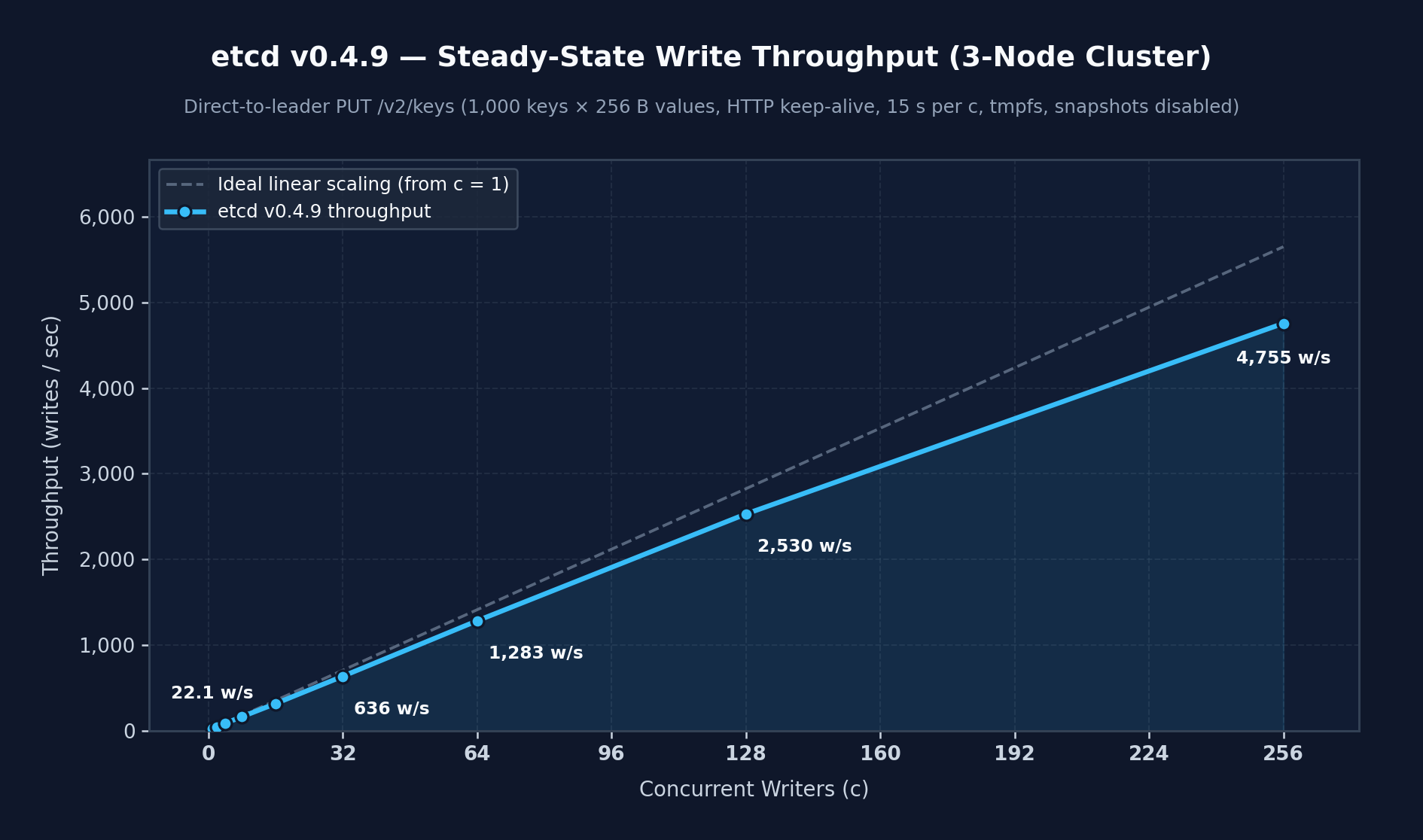
At c = 1, sequential writes align with goraft's 50 ms Peer.heartbeat() interval, keeping single-client throughput near the 20 writes/s ceiling. As concurrency increases, multiple appends accumulate in /var/lib/etcd/log during each heartbeat sleep and flush together in the next AppendEntries request, so throughput initially scales close to linearly. At the highest concurrency (c = 256), the curve drops below the dashed ideal linear line as writers saturate the leader's single core behind Log.mutex and unbatched per-entry Seek/Write syscalls.
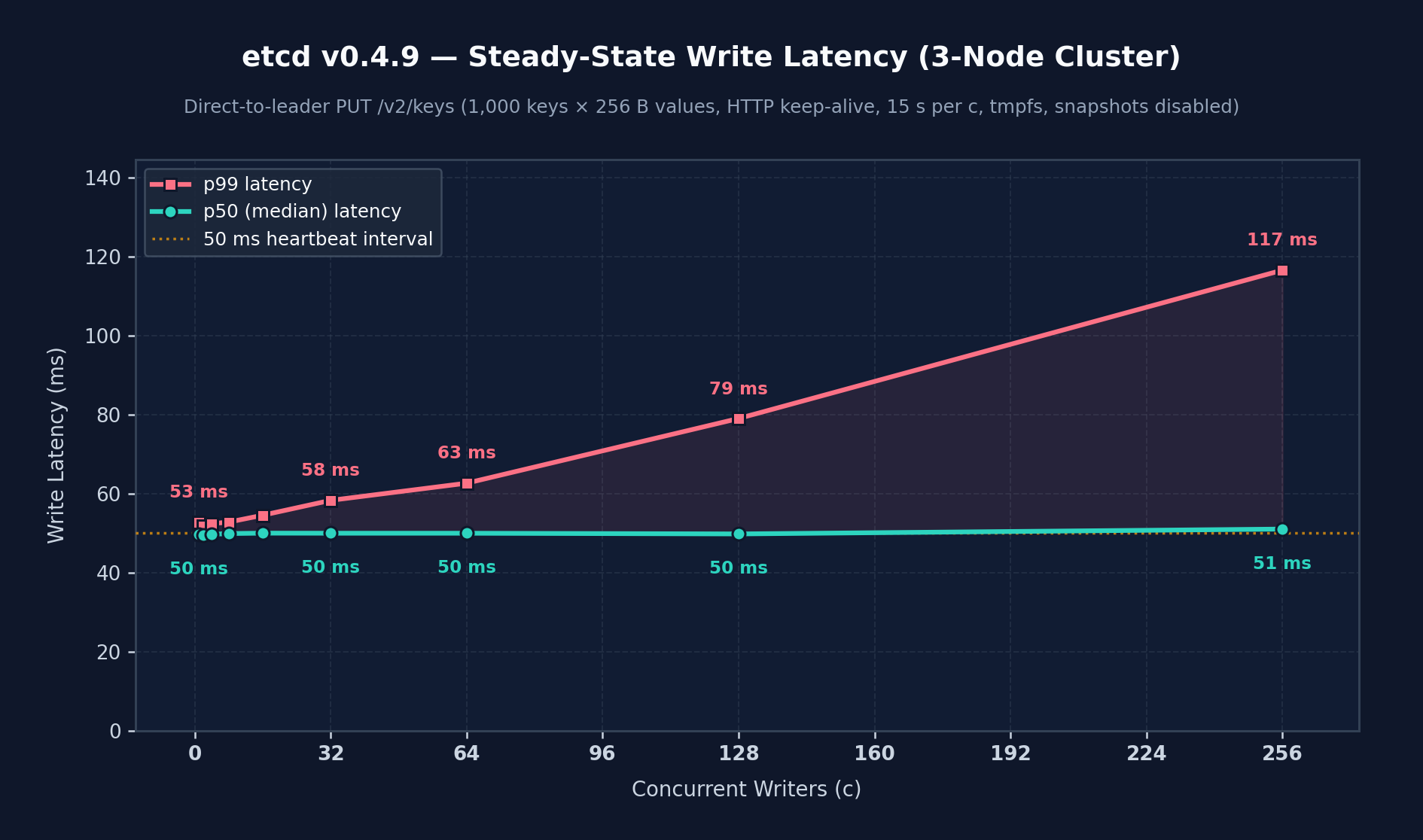
Per-request latency confirms both bottlenecks. Across the entire concurrency sweep, median latency (p50) remains flat at the 50 ms heartbeat interval. Meanwhile, p99 tail latency climbs steadily as batches grow and eventually exceeds two full heartbeat cycles at c = 256, as writers queue behind serialized log appends and commits.
Stop-the-world snapshot and log-rewrite stalls. These steady-state numbers only hold while /var/lib/etcd/log appends uninterrupted. Every 10,000 commits (snapshot_count), PeerServer.monitorSnapshot() triggers TakeSnapshot(), adding a third bottleneck to the write path.
First, store.Save() acquires the exclusive worldLock to deep-clone the tree, marshals it to JSON twice (base64-encoding the inner JSON into the outer .ss file), and fsyncs the snapshot. Next, Log.compact() acquires Log.mutex.Lock(), writes the surviving tail entries into log.new, calls file.Sync(), and atomically replaces /var/lib/etcd/log via os.Rename. All in-flight appends and commits stall until this rewrite finishes.
Looking Ahead to Part 2
By late 2014, the CoreOS team realized that goraft's coupling, persistence hazards, and write-path bottlenecks could not be solved with incremental patches. Making etcd reliable enough for production meant rebuilding its consensus engine, on-disk write-ahead storage, and peer replication from scratch. The goals were deterministic and unit-testable state transitions, corruption checks for every persisted record, and a write path free of timer-polling and unbatched syscall stalls.
This rewrite shipped in January 2015 as etcd v2.0. In Part 2, we will examine etcd v2's redesigned consensus and storage architecture, run the same 3-node benchmark to see how much changed, and look at what happened when rapid production adoption brought much larger workloads to etcd.
If you liked this post, you can support me on ko-fi.


Top comments (0)